


Summary:
Life insurance often plays a role in a comprehensive financial plan. In this blog, learn about:
- The concepts and definitions essential to understanding life insurance
- Various types of life insurance available
- Why life insurance matters
Life Insurance is never a fun topic to talk about – discussing our mortality is uncomfortable – but having a plan in place for the people you care about allows you to pursue your goals. As part of a financial plan we can use life insurance for both financial goal-driven planning and estate planning. Sometimes life insurance carries a stigma due to the potential of being an investment that doesn't pay off, so the hope is that this educates and aids in deciding when to leverage this financial planning tool.
Definitions
Here are the fundamental concepts and definitions essential to understanding life insurance:
- Life Insurance Policy: a contract between an insurance company, the insurer, and an individual or business, the insured. The insured or owner of the insurance policy agrees to pay the insurer premiums in exchange for the insurers agreement to pay a specified and agreed upon dollar amount, the death benefit, if somebody passes away.
- Premiums: the regular payments that the insured pays to the insurance company to keep the life insurance policy contract in place. Often, these are paid on a monthly, quarterly, or annual basis.
- The insurer: the company that issues the life insurance policy and who pays the death benefit in the event of the insured passing away.
- The insured: the person whose life is covered by the policy, meaning that they are the one whose death triggers payout of the death benefit.
- The death benefit: the amount of money paid by the insurance company if the insured passes away.
- The beneficiary: the individual or business who receives the death benefit if the insured passes away.
- The policyholder or policy owner: who pays the premiums to the insurance company. The policyholder and the insured can be the same person, but they do not have to be. Likewise, the policyholder can be the beneficiary, but they do not have to be.
- Underwriting: a risk assessment that the insurance company uses to determine if they will offer a policy to the proposed-insured and the amount of premium cost to purchase that policy.
- Cash Value: a component of permanent life insurance that is a savings or investment sub-account that grows tax-deferred over time. This sub-account is separate from the death benefit.
Types of Insurance
There are different types of life insurance, each with pros and cons of their own that may factor into your financial plan in different ways.
Term life Insurance: Term insurance is as the name indicates: it’s good for a specific amount of time for a pre-approved and set death benefit with a fixed premium.
Example: the insured, John Doe, has $500,000 of Term Life Insurance with a $50 per month premium for a term of 20 years. Every month, John pays the insurance company $50. If John dies within the 20 year term, his beneficiary, Jane Doe, receives a check from the insurance company for $500,000. If John doesn’t pass away within the 20 year term, the contract ends. There is no $500,000 payout and the insurance company keeps all of the premiums.
Some term policies come with a provision to renew the term, or convert the term policy to a permanent policy (more on permanent policies later). If the term policy does have the annually renewable provision and John Doe decides to extend his $500,000 life insurance policy, the premium may increase.
Some other things to know about Term Life:
It’s typically cheaper than Permanent insurance
Most term life insurance policies range from 10 years of coverage up to 30 or 40 years.
Some Term policies do not require underwriting if the death benefit or the term length of the policy is low enough or if you pass some basic pre-screening health questions.
Sometimes employers offer life insurance policies as a benefit to their employees, these policies are often term policies.
Fun fact: Term insurance is usually cheaper for women than men because, statistically, men participate in more dangerous activities than women usually do. On average, women tend to live longer, so they are cheaper to insure.
Permanent life insurance is, again, as it sounds, permanent. Unlike term life insurance, permanent life insurance is designed to last for the insured’s lifetime, or up to age 120, as long as the premiums are paid. Permanent insurance has two components: a death benefit and a cash value subaccount that grows over time. The cash value grows over time as a portion of every premium payment is funneled into the cash value subaccount. The cash value can be accessed by the policyholder while the insured is still alive. But the cash value and the death benefit are connected, meaning that accessing the cash value through loans or withdrawals will affect the amount of the death benefit the beneficiary will receive if the policyholder dies. There are two ways to access the cash value:
Loans: If you take a loan from your permanent life Insurance policy cash value, you will repay it on a pre-determined and agreed upon payment schedule plus interest to the insurance company. If the insured dies before repaying the cash value loan amount, the death benefit is reduced dollar for dollar by the amount of the loan remaining.
Withdrawals: If you withdraw from your policy’s cash value, it reduces the death benefit dollar for dollar.
Example: If John Doe has a $500,000 permanent policy with $25,000 cash value and John wants to take $5,000 out of his cash value amount, the death benefit for the beneficiary is then reduced by that $5,000 and is now $495,000.
Types of Permanent Insurance
We’ve covered the difference between term and permanent life insurance, but there are several types of permanent insurance to know about.
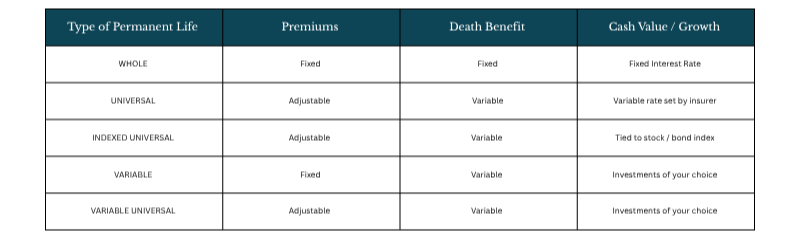
Whole Life: This one is simple! It provides lifelong coverage with level (fixed) premiums, meaning if your premiums are $500 a month, they’ll stay that way for the life of the policy and the policy will remain in force as long as premiums are paid. The cost remains the same for the duration of the policy; premiums never change. People like whole life insurance policies because it contains NO surprises.
The cash value in a whole life policy grows tax-deferred at a fixed rate that is set by your insurer. The rate is typically anywhere from 1% to 4% and those returns are guaranteed. The cash value in a whole life policy grows slowly and steadily and it can take years to build up enough cash value to begin tapping into that cash.
Typically, whole Life is the most expensive of the permanent insurance options.
Universal Life: Universal life (UL) also provides lifelong coverage, but you can adjust your premium rate and coverage amount over time as your needs and financial situation change. Because they are permanent policies, these policies come with cash value growth based on the type of UL that you choose.
Fixed universal life: The cash value grows at a guaranteed set rate.
Indexed universal life: The cash value growth is linked to a market index (like the S&P 500), with caps and floors to limit growth and losses.
Variable universal life: This type of UL offers policyholders the opportunity to invest cash value in investments of their choosing which can make cash value performance higher risk. You can also include cash value in the death benefit.
Guaranteed universal life: This type of permanent policy focuses on the lifelong guarantee of a death benefit, with predictable premiums, rather than an emphasis on cash value growth.
Some important things to know about Universal Life policies:
They can remain in effect for your entire life as long as the premiums are paid.
Because the premiums are flexible over time, they adapt well to changing financial needs.
There are tax advantages because the cash value grows tax-deferred.
You always want to monitor your Universal Life policies because they are complex. It’s important to monitor and update premium payments and death benefit amounts, and to monitor the growing cash value and its investment performance.
If you find yourself in a circumstance where you can’t pay your premium, you can opt for your cash value to fund your premium, but you’ll need to make sure you have sufficient cash value to do so.
Here’s a quick visual of the different types of Permanent Life Insurance:
Reasons to Consider Insurance
Life insurance comes into play for so many reasons!
An obvious reason to consider life insurance is for earnings replacement. If you have a family who relies on your income and you pass away, life insurance can replace your income so your family can continue to pay bills and maintain the standard of living that they’re used to. Additionally, a death benefit can help important expenses that come with the passing of a loved one such as medical bills, funeral costs, probate, estate taxes, etc.
Another consideration for life insurance is if you have outstanding debts like a mortgage, student loans, car loans, or consumer debt. Those debts don’t go away when you pass away and life insurance can lessen the burden on your family and estate.
Even if you don’t earn an income, you may be a caretaker of young children, dependents with special needs, or aging parents. Those caretaking duties are costly to replace in the event of your passing and a death benefit can help cover the expenses to maintain care.
Additionally, you may want to leave an inheritance or support charitable causes.
And finally, some people see an opportunity to build cash value as part of a permanent life insurance policy as an additional means of accessing funds in the event of an emergency expense.
Life Insurance in Your Plan
We’ve defined and explained life insurance, but you may find yourself wondering things like “what type of life insurance policy is best for my family right now?”, “how much life insurance should I have?” “Is my employer policy enough?”, “do I have too much life insurance?”. These questions can be overwhelming, and that’s where we come in.